
Why the 1917 Wheat Penny Still Attracts Collectors
The 1917 Wheat penny value represents one of the developmental stages of the Lincoln series initiated in 1909.
The coin was struck from an alloy consisting of 95% copper and a 5% mixture of tin and zinc.
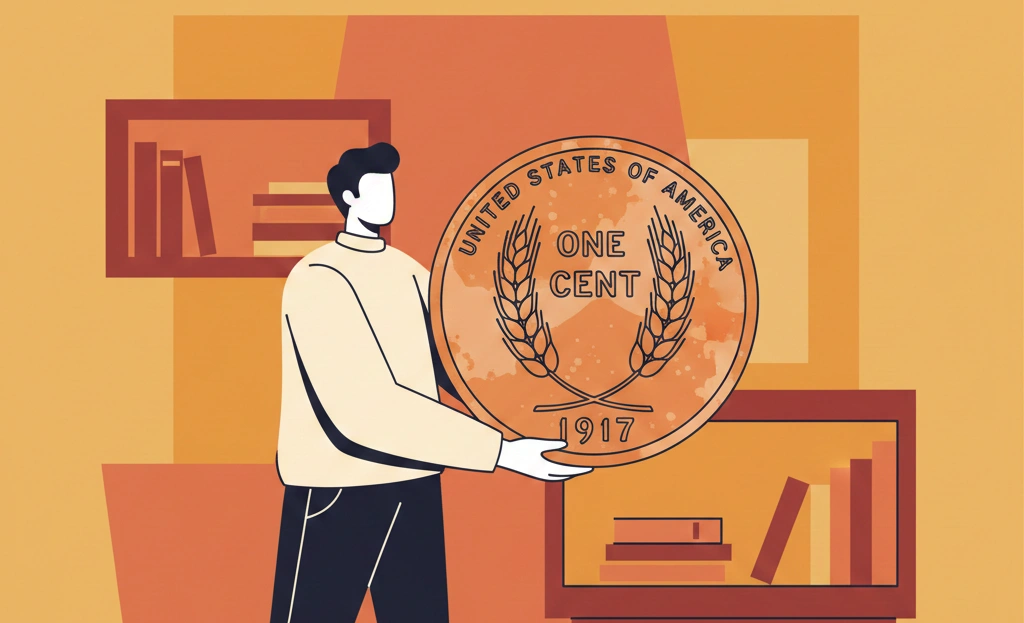
The mass of a standard specimen is fixed at 3.11 grams.
The product diameter measures 19 millimeters with a plain edge.
Designed by Victor David Brenner, the obverse design contains an image of Abraham Lincoln's profile.
The coin reverse is classified as the "Wheat Penny" type due to the presence of two wheat stalks.
In 1917, production was carried out at three facilities of the United States Mint.
Mint | Mark | Mintage |
Philadelphia | None | 196,429,785 |
Denver | D | 55,120,000 |
San Francisco | S | 32,620,000 |
A total mintage volume of 284.1 million pieces ensures the constant presence of the coin on the market.
Mintage Survivability Assessment and Color Categories
Early 20th-century copper coins underwent intensive oxidation during the circulation process.
Market demand correlates directly with the preservation of the original mint color.
Strictly regulated categories exist: Brown (BN), Red-Brown (RB), and Red (RD).
PCGS population report statistics indicate a sharp reduction in the number of surviving specimens in the RD category.
For the 1917 Philadelphia issue, over 1,500 coins are certified in MS65 RD grade.
Moving to the MS67 RD grade, the number of confirmed samples drops to 130 pieces.
Only 2 specimens are recorded in MS68 RD grade for the Philadelphia issue.
Impact of Color Gradation on Price
Example: 1917-P MS65
Color Category | Average Price ($) | Value Multiplier |
Brown (BN) | 35 | 1.0x |
Red-Brown (RB) | 75 | 2.1x |
Red (RD) | 225 | 6.4x |
Data confirms that preserving the original metal color increases the asset value more than sixfold.
Auction Activity and Price Records
Sales at public auctions demonstrate high liquidity for 1917 coins in the upper preservation segment.
In 2023, a 1917 (P) specimen in MS68 RD grade was realized for 33,600 US dollars.
For the 1917-D Denver issue, the record stands at 58,800 US dollars, recorded in 2021 for an MS66+ RD grade.
The 1917-S San Francisco issue in MS66 RD grade sold for 25,875 US dollars.
Statistics show that the price for MS66 RD specimens grew by an average of 5.2% annually between 2010 and 2020.
A stabilization of prices with minor fluctuations within 1.5% per year is observed between 2021 and 2024.
Varieties and Mint Errors
The absence of major doubled die varieties in 1917 is compensated for by the presence of production errors.
Interest in the issue is maintained through verified technological deviations.
Struck on a Silver Dime Planchet: An error occurring when a 10-cent blank entered the cent press. The value of such coins reaches 5,000 dollars.
Die Cracks: A common phenomenon for 1917, increasing the price by 5–15 dollars.
Broadstrikes: Striking outside the collar ring, leading to an expanded diameter. The value varies from 100 to 350 dollars.
The strike quality in San Francisco (S) is traditionally considered lower due to the use of worn dies.
1917-S specimens possessing full detail (Sharp Strike) are encountered significantly less frequently than the market average.
Investment Parameters and Volatility
The 1917 coin market is characterized by a high degree of segmentation.
Specimens in G-4 to VF-20 condition are valued within the 0.50–2.00 US dollar range.
Volatility is absent in this segment, with the price tied to the face value and copper content.
Investment profitability appears only upon reaching MS65 grade and higher.
1917-D MS65 RD Price Dynamics (2012–2026)
2012: 1,800 US dollars.
2018: 2,400 US dollars (33% increase).
2024: 2,850 US dollars (18% increase over the previous period).
The average annual growth rate for rare Denver positions is approximately 4.2%.
The risk of depreciation remains minimal due to the absence of new large hoards of this year's coins in MS condition.
Preservation Factors and Grading Risks
1917 copper is extremely sensitive to humidity and chemical influences.
Most coins stored outside airtight capsules undergo darkening.
The presence of carbon spots reduces coin liquidity by 30–50%.
Professional cleaning (Restoration) is frequently detected by the PCGS / coin checker app, leading to the denial of a numerical grade.
Coins labeled "Details" trade at a significant discount relative to market quotes.
Understanding the 1917 value requires comparison with 1916 and 1918.
The 1917 Philadelphia mintage is higher than the 1916 (131 million) and 1918 (288 million) figures.
Despite the high mintage, 1917 shows higher value in MS67+ grades due to specific production conditions.
The survival rate of coins in perfect condition for 1917 is lower than for 1918.
This creates a supply deficit at high-level auctions.
Role of Professional Certification
Selling 1917 coins valued above 100 US dollars is impossible without certification.
PCGS and NGC laboratories provide a guarantee of authenticity and accurate color determination.
The difference between Red (RD) and Red-Brown (RB) categories is determined instrumentally.
Erroneous visual coin value app assessment without utilizing standards leads to financial losses during resale.
The certificate number allows for tracking the auction sales history of a specific specimen.
Global Supply and Market Trends
Currently, the market is saturated with 1917 coins in Brown (BN) condition.
A steady trend exists toward removing medium-quality coins from collections in favor of high-quality certified samples.
Trading volume for 1917 on eBay accounts for thousands of transactions monthly.
Most turnover involves coins priced under 10 dollars.
Institutional investors focus on coins with a grade of at least MS66 RD.
Conclusion
The 1917 one cent remains a fundamental element of American numismatic collections.
Its desirability stems not from mintage scarcity, but from the rarity of preserving original metal characteristics.
Statistical data confirms the stability of the asset in the long term.
The cost of ordinary specimens remains low, ensuring accessibility for basic study.
The value of rare grades is formed by the confirmed deficit in population reports and a transparent history of auction trades.